
August 27, 2026
Search for San Bruno's median home price this month and you'll get two answers that don't seem to describe the same city. One says the typical home sold for roughly $1.5 million. Another says $442,000. Both are correct. They're just answering different questions.
That gap isn't a data error, and it isn't the market swinging wildly month to month. It's what happens when two structurally separate housing markets get compressed into a single citywide statistic. If you're comparing San Bruno to Millbrae, Burlingame, or South San Francisco based on a headline median, you're comparing a number that describes almost nothing about the actual property you'd be bidding on.
According to MLS data for July 2026, San Bruno's single-family homes sold at a median price of $1,516,940, up 2.5% from a year earlier. In that same period, condos and townhomes in the city sold at a median of $442,000. That's not two tiers of the same product. It's a nearly 3.5x spread between a detached house and an attached unit, inside one zip code, in one month of closings.
Citywide aggregators that blend every closed sale into one number will land somewhere in between those two figures depending on which properties happened to close that particular month. A month with more condo turnover pulls the blended median down. A month with more hillside single-family sales pulls it up. None of that reflects appreciation or depreciation. It reflects which slice of San Bruno's housing stock happened to trade hands.
If you're pricing a purchase or a listing off a citywide median, you're not pricing against San Bruno. You're pricing against whatever random mix of condos and houses sold last month.
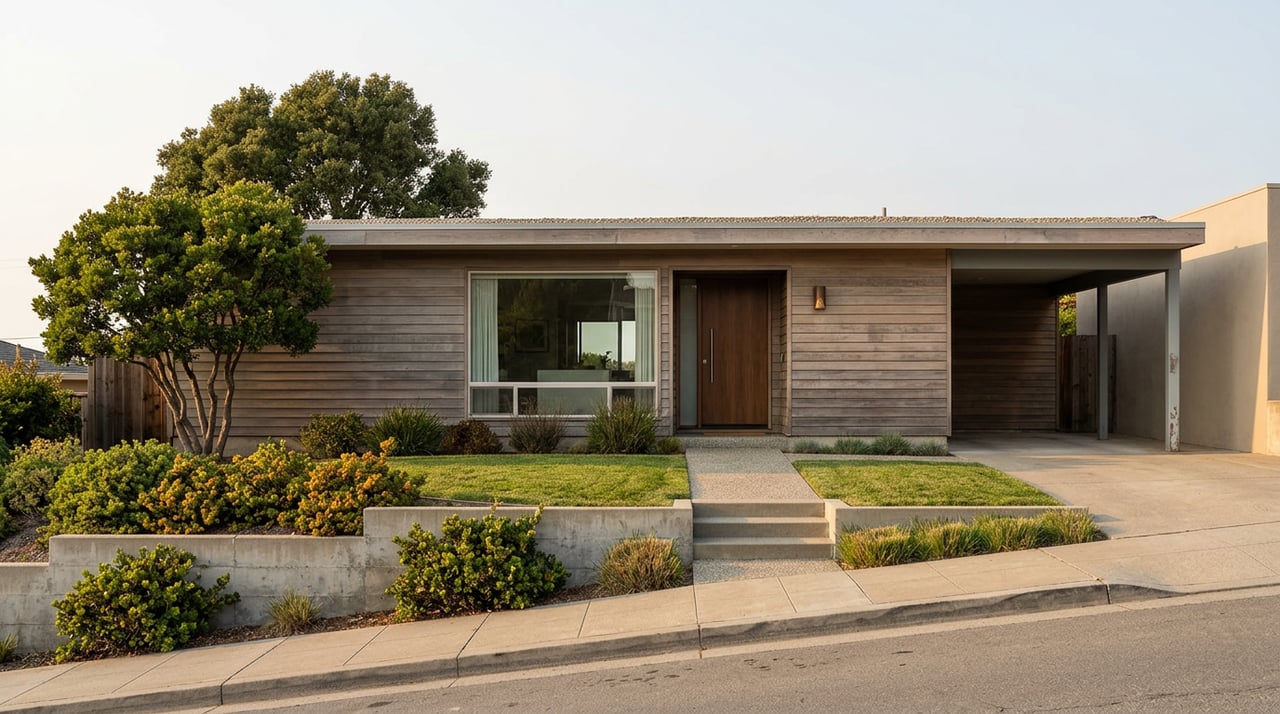
The reason the split is this stark comes down to geography, and San Bruno's geography is unusually compressed. The flatland streets near San Bruno Avenue and the Tanforan district sit close to San Francisco International Airport's approach and departure paths. The hillside neighborhoods above them, Crestmoor, Pacific Heights, and Rollingwood, sit higher and farther back, largely out of the noise corridor and looking down over the bay instead of up at incoming aircraft.
Federal noise regulation draws a hard line here. As SFGate reported, airports are required to keep noise exposure under a 65-decibel threshold, and a computer-modeled noise contour built from that threshold has historically determined which homes qualify for airport-funded soundproofing. More than two decades ago, that program put real money into San Bruno specifically: roughly $11 million was allocated to insulate about 490 homes in the city, part of a broader Peninsula-wide effort that also reached Daly City and San Mateo County. That funding targeted the flatland streets closest to the runways, not the hill.
Buyers comparing a flatland condo to a hillside house aren't just comparing square footage. They're comparing two different acoustic environments that happen to share a mailing address.
As KRON4 reported, San Bruno is home to YouTube's headquarters campus at 901 Cherry Avenue, a 540,000-square-foot complex that Google has continued to expand, adding office buildings on nearby Bayhill Drive as recently as 2023. Walmart also maintains an office in the city. That's a concentrated base of senior tech salaries anchored inside city limits, not commuting in from San Francisco or Silicon Valley.
That buyer pool doesn't distribute evenly across San Bruno's housing stock. It concentrates in the same neighborhoods that already benefit from elevation and views, because those are the homes that read as move-up purchases rather than starter units. The result is a feedback loop: the hill neighborhoods get both the quiet and the demand, while the flatland gets neither in the same proportion. A citywide median can't separate an elevation premium from an employer-proximity premium. It just averages them together and calls it San Bruno.
The flatland side of that split is about to be tested. KRON4 reported that the Shops at Tanforan, a shopping center that had operated for more than 50 years, sold for roughly $300 million with plans to convert the site into biotech office space. San Bruno's mayor, Rico Medina, framed the broader wave of corporate investment as evidence the city remains a partner of choice for major employers expanding in the area.
What that sale doesn't do is add housing. It adds office density to a flatland corridor that's already the cheaper, noisier, more transit-oriented half of the city's split market. If biotech office space brings a new wave of daytime workers to Tanforan without a matching increase in nearby housing supply, the flatland's value proposition shifts toward convenience and transit access rather than proximity to schools, which is a different pitch than the one that's driven hillside pricing. It's worth watching whether that changes how flatland condos get valued over the next year, because right now that entire side of the market is priced almost entirely on affordability relative to the hill, not on proximity to a growing office cluster.
If you're cross-shopping San Bruno against Millbrae, Burlingame, or South San Francisco, the citywide median is close to useless as a comparison point. What actually matters:
Does every home near SFO qualify for free soundproofing? No. Eligibility has historically been tied to a federally modeled 65-decibel noise contour, not simply distance from the runway. Two homes a few blocks apart can fall on opposite sides of that line.
Is San Bruno actually cheaper than Burlingame or Millbrae? It depends entirely on which San Bruno you're comparing. The condo and townhome tier undercuts both cities by a wide margin. The hillside single-family tier, especially in Crestmoor and Pacific Heights, competes much more closely with Burlingame's flatter, non-view neighborhoods.
If you're trying to figure out which San Bruno actually fits your budget and your tolerance for airport noise, that's not a question a median price can answer. It takes someone who can walk a specific street with you and tell you which side of the split it falls on.
Nick Villanueva works San Bruno and the surrounding Peninsula cities every week. Reach out for a neighborhood-specific read on a listing, or get your instant home valuation to see where your property actually sits in the split.
This article is general information, not legal, tax or financial advice. Consult a qualified professional about your situation.
Explore additional blogs for helpful tips and real estate knowledge.

Partner with Nick Villanueva for expert guidance, trusted service, and results that matter.
GET IN TOUCH
NICK VILLANUEVA | CA DRE# 02147224
ADDRESS 2 TOWER PL STE 1380 SOUTH SAN FRANCISCO CA 94080